Demographics versus jobs: Why India's youth bulge and China's aging workforce yield the same crisis
India is experiencing a youth population boom while China faces an aging workforce, yet university graduates in both Asian giants face identical structural barriers to finding work.
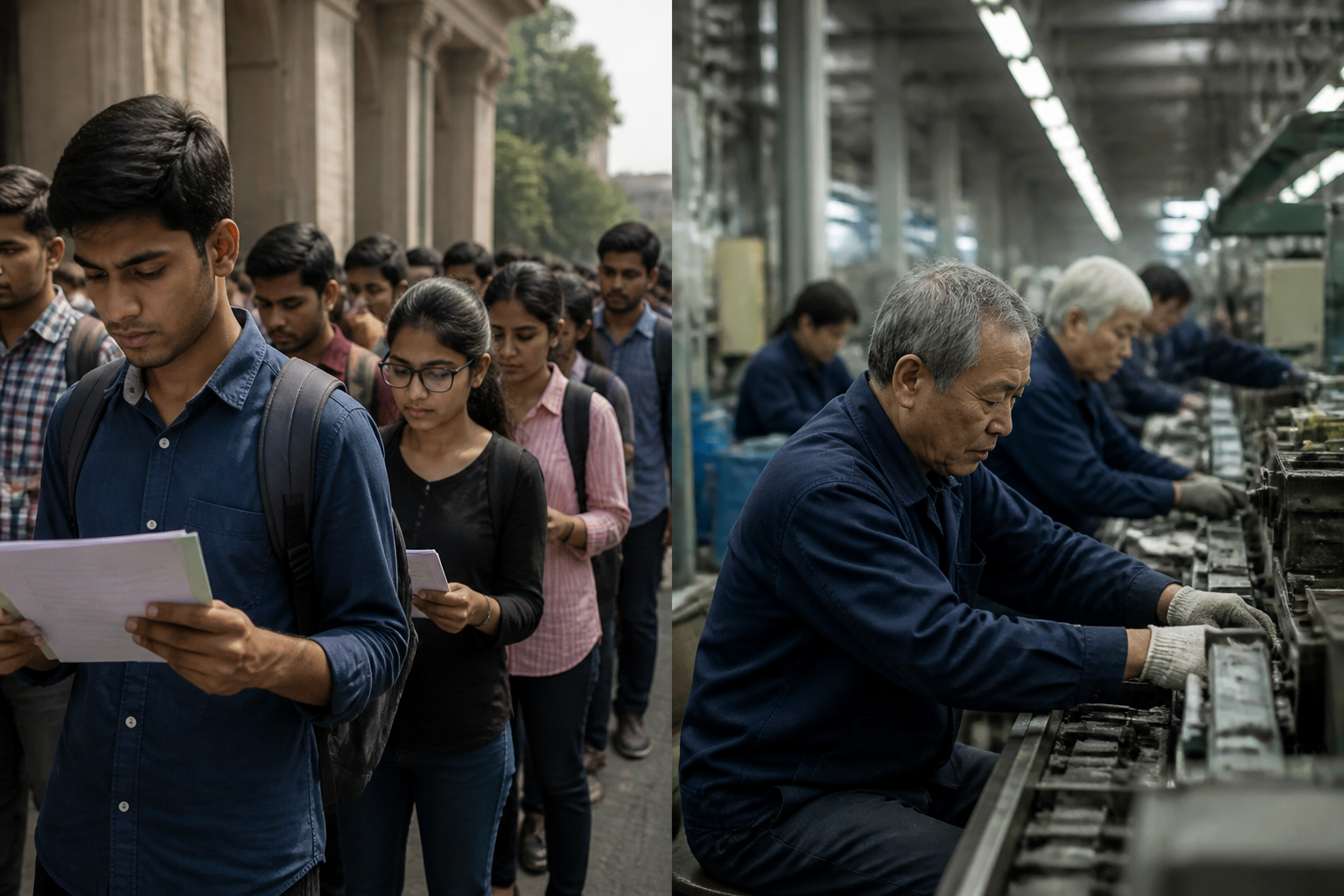
Asia’s two economic juggernauts are moving in completely opposite demographic directions, yet both have arrived at the exact same economic impasse: millions of highly educated young people cannot find work.
India is currently riding the largest demographic dividend in human history, with a massive youth bulge entering the workforce every year. China, conversely, is grappling with a rapidly aging population and a shrinking working-age demographic following decades of strict family planning policies. Despite these contrasting population realities, fresh university graduates in both nations face a bleak labour market where formal employment opportunities are drying up, according to reporting by DW.
This shared paradox highlights a growing structural disconnect in developing and emerging economies. Producing record numbers of university graduates does not automatically create high-skilled jobs, leaving two very different demographic engines sputtering under identical structural pressures.
Contrasting demographics, shared failure
The mathematical assumption used to be simple: India’s demographic boom would provide a limitless supply of young labour to drive growth, while China’s maturing economy would smoothly transition into high-tech, high-value employment. Instead, both models are confronting serious friction at the entry level of the job market.
In India, the challenge is an overwhelming volume of jobseekers hitting a market that has failed to generate sufficient formal sector positions. Millions of young Indians earn degrees each year, only to discover that available employment is largely concentrated in low-wage, informal, or gig-economy roles that do not require higher education.
China presents the inverse problem. Despite a shrinking youth population, the country is graduating record cohorts of university students into an economy that has slowed in key graduate-absorbing sectors such as technology, real estate, and private tutoring. The result is a severe skill mismatch: young Chinese jobseekers are overqualified for factory floor work, while white-collar expansion has stalled.
The graduate trap and structural mismatch
Why are these different demographic trajectories producing the same result? The core issue lies in modern educational expansion outpacing structural economic transformation.
In both countries, university enrollment has surged over the past two decades as families invested heavily in higher education to secure upward mobility. However, economic policy in both Beijing and New Delhi has struggled to build industries capable of absorbing millions of degree-holders simultaneously.
- The supply shock: University systems in both countries continue to pump out millions of graduates annually into saturated traditional sectors.
- The credential mismatch: Employers in technical sectors frequently report that graduates lack practical, market-ready skills, while graduates resist taking entry-level manual jobs.
- Economic re-alignment: In China, regulatory crackdowns and shifting global supply chains have constrained private-sector hiring. In India, capital-intensive growth has failed to deliver labor-intensive manufacturing hubs at the necessary scale.
This dynamic has created a generation of underemployed youth in both nations, raising long-term questions about social mobility and economic stability.
What happens next
Addressing these twin crises will require substantial policy shifts in both capitals. India must urgently accelerate labor-intensive manufacturing and service sector expansion to absorb its expanding labor force before its demographic window closes. China must navigate a complex transition toward high-end manufacturing and service industries that match the expectations of its smaller, highly educated youth population.
If neither country can realign its higher education pipeline with real market demand, the risk of prolonged youth underemployment will continue to weigh on Asia's primary growth engines. Economists and policymakers will be watching upcoming labor data closely to see if recent industrial policies can bridge the gap between classroom degrees and actual payrolls.