Screening the Corridors: Inside East Africa’s Border Defence Against Bundibugyo Ebola
Targeted border screening and rapid surveillance protocols are being tested across East Africa’s transit corridors as authorities race to contain the spread of the Bundibugyo Ebola strain.
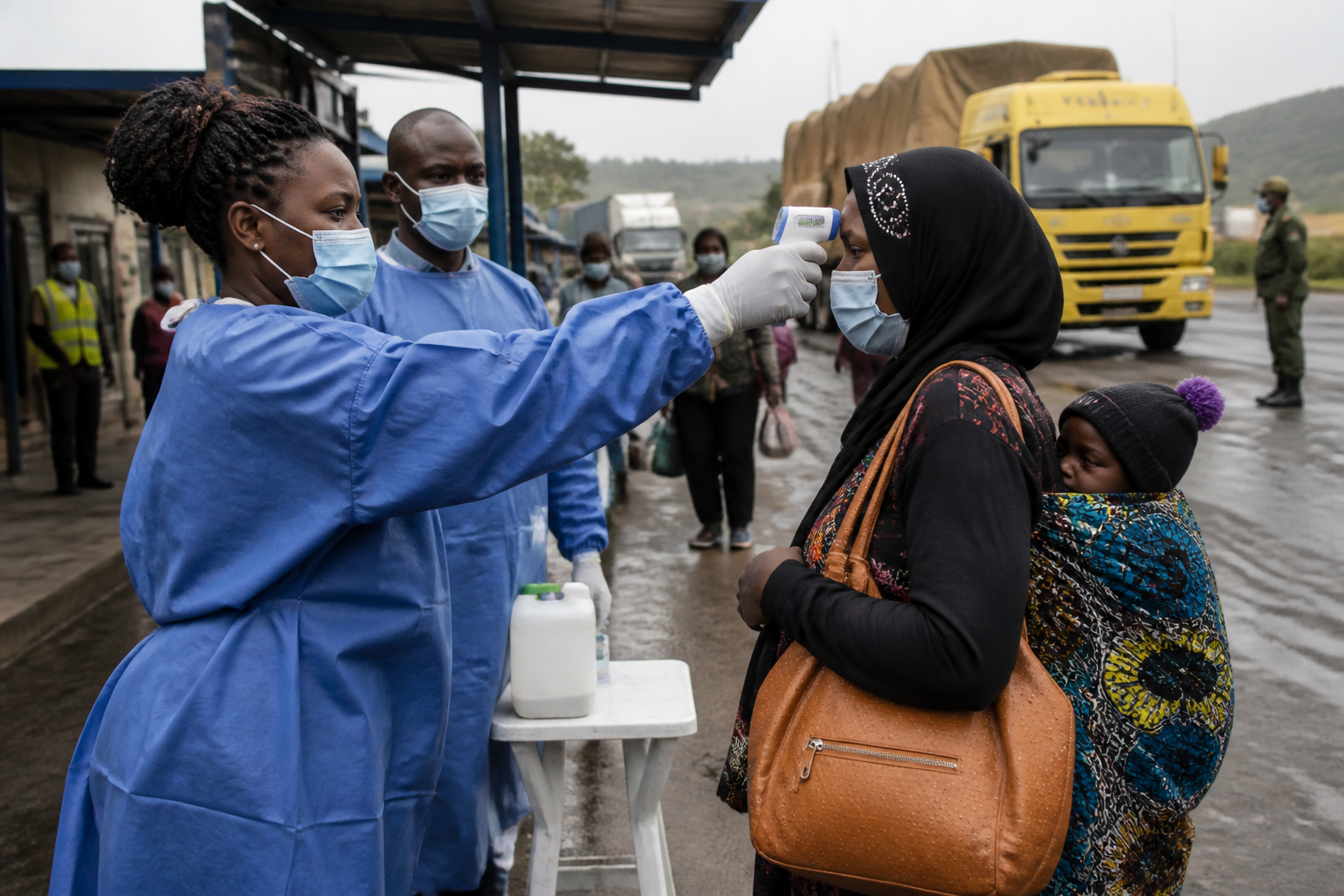
Point-of-entry health screening and rapid regional surveillance protocols are currently serving as the primary defensive line against the cross-border spread of the fatal Bundibugyo Ebola strain across East Africa. As the viral outbreak threatens transit corridors linking the Democratic Republic of the Congo (DRC) to neighbouring states, border authorities have instituted targeted thermal monitoring, traveller tracking, and health declarations to intercept infections before localized transmission can take root.
According to figures published by AllAfrica, border and port authorities in Kenya have already screened more than 34,500 travellers across the country's airports, seaports, and land crossings. In tandem, Ugandan health officials have conducted screening on over 34,500 travellers entering from eastern DRC, where high levels of human movement along porous boundaries present an ongoing risk of viral exportation.
The current public health response relies on managing transit pathways that connect conflict-affected zones in eastern Congo to major urban population centres, including Kampala. By focusing operational mechanics at border checkpoints, regional health bodies aim to construct a buffer system capable of detecting symptomatic individuals without completely halting critical economic traffic.
Cross-border screening mechanics along regional transit routes
The cross-border containment strategy operates through established point-of-entry health protocols designed to catch suspected Ebola cases in transit. According to coverage by Capital FM, cited by AllAfrica, the Kenyan government has opted against enforcing a blanket quarantine on incoming arrivals, choosing instead to rely on targeted screening at key entries to monitor potential importations.
In Uganda, response efforts are anchored by the activation of rapid response teams trained to handle potential infections crossing from eastern Congo's Ituri Province. Reporting by AllAfrica indicates that Uganda's health apparatus is leveraging past outbreak experience to manage the movement of populations along common border points, where informal crossings routinely complicate standard containment measures.
Despite these measures, surveillance systems face severe structural hurdles due to the geography of the borderlands. AllAfrica reports that extensive human movement across porous frontiers continues to spark fears of sustained local transmission within Uganda, particularly as infected individuals cross before symptoms fully manifest or are formally detected.
Financial commitments and systemic obstacles
Efforts to scale up point-of-entry monitoring are unfolding alongside larger international and national funding drives. According to Reuters, the World Health Organization (WHO) launched a $518 million six-month strategic plan to curb the outbreak and assist neighbouring nations with enhanced border screening. This follows the Africa Centres for Disease Control and Prevention (Africa CDC) declaring the DRC's 17th Ebola outbreak on 15 May 2026, which was subsequently designated a public health emergency of international concern by the WHO.
However, total funding figures across regional frameworks reflect varying financial estimates. While Reuters cites the WHO's $518 million global response plan, reports carried by AllAfrica note an estimated $319 million response strategy requirement alongside a dedicated Shs90 billion plan proposed specifically by Uganda to secure its borders and healthcare infrastructure.
| Region / Entity | Stated Financial Plan / Estimate | Primary Operational Focus |
|---|---|---|
| WHO International Strategy | $518 million (6-month plan) | Regional containment, border screening, outbreak control |
| Regional Strategy (AllAfrica) | $319 million | Coordinated cross-border response and surveillance |
| Uganda National Plan | Shs90 billion | Border protection, rapid response teams, healthcare capacity |
Analysis of the containment campaign highlights that border security alone cannot isolate the virus if surveillance fails at the point of origin. Reuters reports that the epidemic went undetected for weeks in eastern Congo, leaving health agencies playing "catch-up" against a fast-moving virus. Insecurity, healthcare worker infections, and widespread misinformation across the DRC and Uganda further erode the efficacy of physical screening checkpoints.
What happens next
Health authorities under the joint coordination of the Africa CDC and the WHO are moving to standardize transit monitoring while urging deeper community engagement to counter public mistrust. As screening efforts persist at high-volume border posts, regional health ministers and epidemiologists are slated to monitor incoming travel data over the coming weeks to adjust point-of-entry protocols and prevent further international spread of the Bundibugyo strain.